QA and facilities teams in Hong Kong factories, warehouses, cold-chain sites, food operations and electronics production.
WITTI LAB · VALIDATING
DampGuard
Open the ticket before condensation or a leak becomes a loss—and connect every alert, owner, escalation and audit record in one chain.
Current stage: buyer and willingness-to-pay validation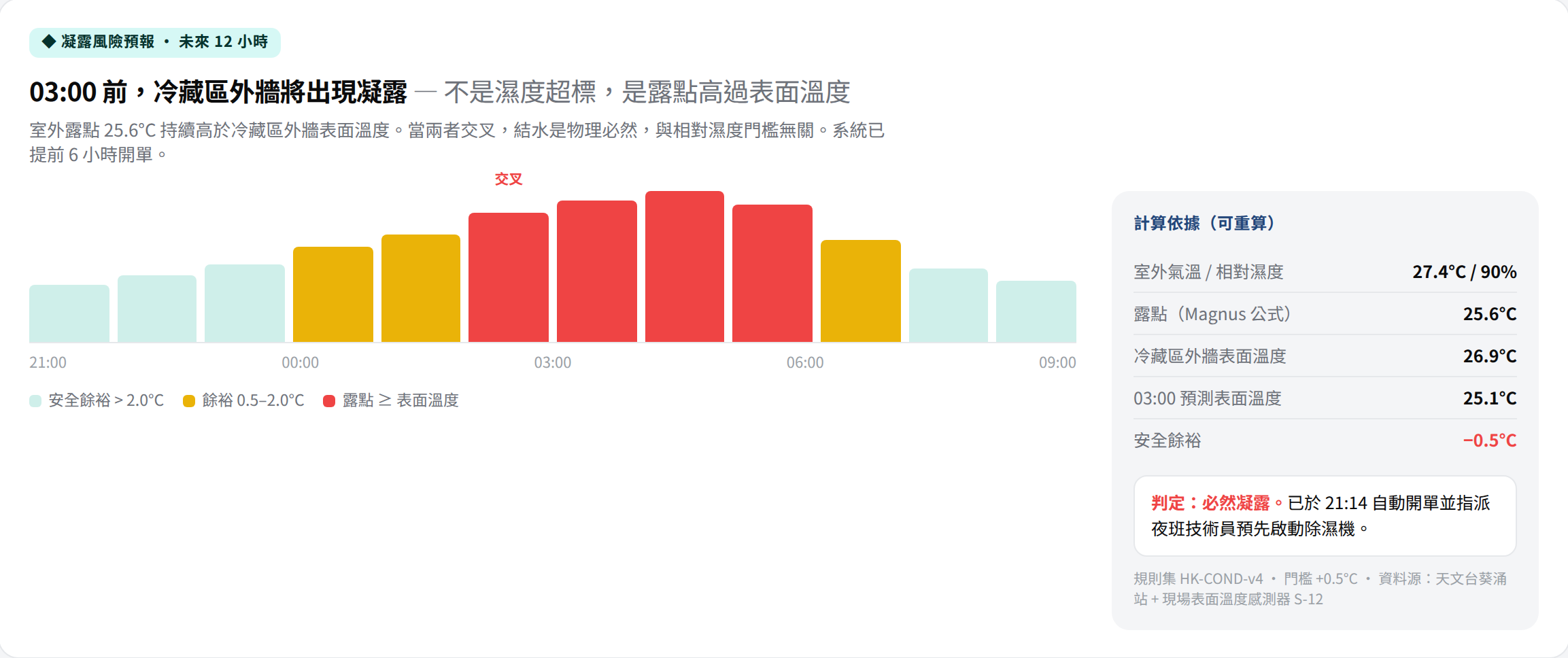
Go beyond the alert: make sure someone owns the response, acts on time and leaves a complete audit trail.
Use existing sensors and LoRaWAN; WITTI focuses on dew-point forecasting, ownership and the evidence software layer.
01 / WORKFLOW
From an environmental signal to an accountable response.
The sensor is only the starting point. The value lies in predicting the risk, assigning the work and proving that the incident was resolved.Receive site readings
Connect leak, humidity and surface-temperature sensors without manufacturing new hardware.
Forecast condensation
Compare dew point with surface temperature and open an incident before moisture forms.
Assign and escalate
Notify the person on duty and automatically escalate when the ticket is not acknowledged.
Close and export evidence
Keep actions, photos and timestamps together and produce an audit-ready report.
02 / PROTOTYPE
More than another water sensor that sends an SMS.
The prototype brings forecasting, incident ownership and audit evidence into one operational workspace.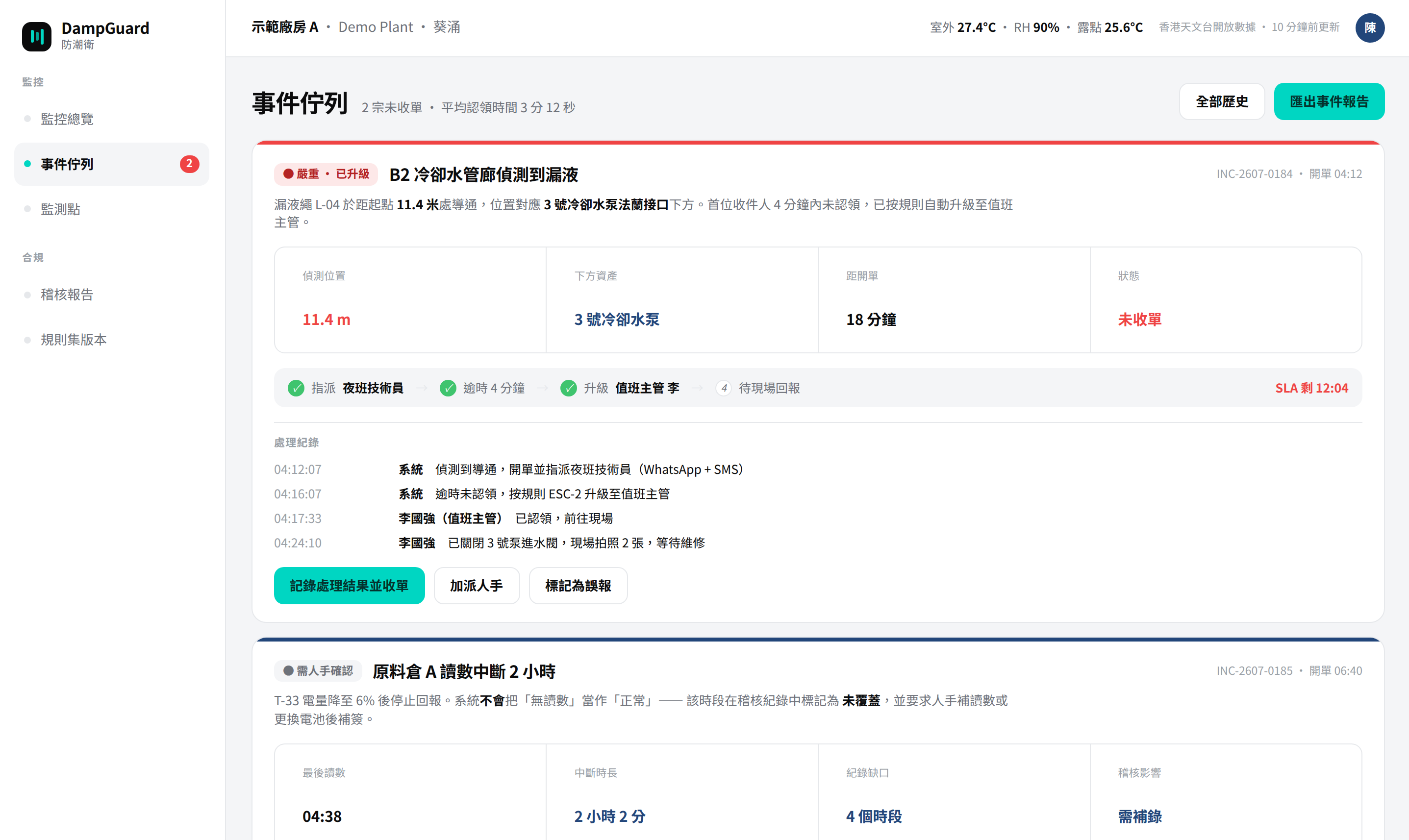
03 / DESIGN PRINCIPLES
Hardware is a commodity. Response and evidence are the product.
Work with existing hardware
Support common sensors and gateways instead of competing with specialist leak-detection manufacturers.
Every alert needs an owner
Each incident has acknowledgement, response time, escalation and closure states.
Every number can be reproduced
Keep the rule version, raw readings and timestamps; reports are not generated from an AI guess.
04 / VALIDATION
What are we validating?
DampGuard is still a WITTI Lab project. The biggest unknown is not technical: will Hong Kong QA or facilities managers pay for the response workflow and audit evidence?
- 01How much time is still spent recording humidity and preparing reports?
- 02Who receives an overnight alert, and what happens when nobody responds?
- 03Would one system for inspections, incidents and evidence be valuable enough to use monthly?
LET’S TALK
What happens after your sensor raises an alert?
Leave your name and work email. We want to understand your inspection, alert and audit process before discussing a validation pilot.
enquiry@wittitech.com05 / FAQ
Common questions
Is DampGuard a leak-detection hardware system?
No. The concept is a software layer above existing sensors, focused on condensation forecasting, incident ownership, escalation and audit evidence.
Is it only for large data centres?
No. It is aimed at Hong Kong factories, warehouses, cold-chain operations, food production, electronics and other high-value areas. Large data-centre sensing projects are outside the proposed scope.
Can the system guarantee that leaks or condensation will not occur?
No. It is intended to identify risk earlier, make sure someone responds and preserve evidence. It does not replace qualified engineering inspection, maintenance or risk assessment.